Unknown's avatar

DITA-Themen bei XML Prague 2016

English >>

Auf dem Programm der XML Prague Konferrenz, wo die Teilnehmer zwischen 7 Monate und 70 Jahre jung sind, stehen immer mehr DITA Themen und Werkzeuge.

Am ersten Tag fand das oXygen Users Meetup statt. George Bina und sein Team haben das neue Produkt oXygen XML Web Author, dessen Zielgruppe DITA-Reviewers und gelegentliche Autoren sind, angekündigt: https://www.oxygenxml.com/webauthor/

This slideshow requires JavaScript.

Ich habe den Web Author gleich auf dem iPhone probiert.

Außerdem, wird die Version 18 des oXygen XML Editors bald herausgegeben, in der noch weitere Möglichkeiten geben wird, DITA-Autoren bei der visuellen Redaktion, sowie DITA-Architekten bei der Implementierung von Einschränkungen und kontrollierten Werten zu unterstützen. Man kann ein bestimmtes Layout mit einem Projekt speichern oder zu einem Framework zuweisen, damit ganze Teams mit den selben Layout-Einstellungen arbeiten können. Einschränkungen (Constraints) werden bald einfach durch einer config-Datei implementiert. Darüberhinaus, könnte man eine ganze XML-Schema lokalisieren, was die Diskussion über DITA-Elemente in beliebigen Sprachen sofort anregte.

Patrik Stellmann hat sein Framework DITA-SEMIA gezeigt: https://github.com/dita-semia
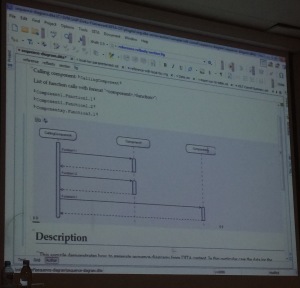
DITA-SEMIA Sequence Diagramms

DITA-SEMIA: Sequential Diagrams

Parallel, in dem BaseX Meetup, hat Eliot Kimber sein Projekt DFST (DITA for Small Teams: http://www.dita-for-small-teams.org/) via Skype vorgetragen.

Maximilian Gärber hat das neue Argon-Author Plugin für DITA Content Management in oXygen und BaseX vorgestellt: argon-author.com Beta-Testers können sich schon anmelden und Argon-Author im BaseX-Sandbox versuchen. Mein kleiner Beitrag dazu, außer die Patentante zu spielen ;), ist das mitgelieferte Demo-DITA-Projekt über Trello.

This slideshow requires JavaScript.

XML Prague läuft drei Tage jeden Februar, voller spannenden Vorträge und Workshops aus der XML/XSLT/CSS/FO-Welt: http://www.xmlprague.cz/

Unknown's avatar

DITA sessions at XML Prague 2016

Deutsch >>

The geeky things you hear at an XML conference with participants between 7 months and 70 years young…

“Convincing W3C into marrying XSL-FO and CSS would be like a shotgun wedding.”

“I fixed a bug just with my iPhone today.”

“You might have a super hammer, but not everything is a nail.”

“There is DITA light and DITA not light.”

Now, for the serious business – the number of sessions about DITA practice and tools at XML Prague keeps growing every year.

On day 1, during the oXygen Users Meetup: George Bina and his team launched their new product oXygen XML Web Author, especially crafted for DITA reviewers and occasional authors: https://www.oxygenxml.com/webauthor/

This slideshow requires JavaScript.

I couldn’t resist trying it out on my iPhone.

Version 18 of the oXygen XML Editor is also coming soon, and brings further features to support DITA authors with visual editing, as well as DITA architects through easier implementation of constraints and controlled values. You can save a certain layout within a project or a framework, so that entire teams would work with the same layout settings. You’ll soon be able to set constraints by just editing a config file. Moreover, you could easily localize an entire XML schema, and this idea immediately triggered discussions about having DITA elements in any language.

Patrik Stellmann has shown his DITA-SEMIA framework in oXygen: https://github.com/dita-semia

DITA-SEMIA Sequence Diagramms

DITA-SEMIA: Sequential Diagrams

On a parallel track, in the BaseX Meetup, Eliot Kimber presented his DFST project (DITA for Small Teams: http://www.dita-for-small-teams.org/) via Skype.

Maximilian Gärber demonstrated the new Argon-Author plugin for DITA Content Management in oXygen on a BaseX database: argon-author.com You can log in as beta-tester and try out Argon-Author in the BaseX sandbox. My humble contribution, besides naming the baby 😉 ,  is the sample DITA project about Trello, included with the plugin.

This slideshow requires JavaScript.

XML Prague runs for three days full of interesting presentations, demos, and workshops from the XML/XSLT/CSS/FO world every February: http://www.xmlprague.cz/

Unknown's avatar

Redakteure beteiligen und richtig schulen

English >>

Es gab eine interessante Discussion auf dem Blog von Larry Kunz über Schulungsbedarf und Geschäftsziele während und nach einer DITA-Implementierung. Ich habe meinen Kommentar schon auf Larrys Seite hinzugefügt, ich trage aber auch hier die Übersetzung ein.

Vielen Dank an Larry, dass er nochmal die Aufmerksamkeit von Projekt- und Abteilungsmanagern auf die Notwendigkeit erregt, die Redakteure frühzeitig zu beteiligen und ihnen so viel Schulung anzubieten wie nötig, damit sie ihre Geschäftsziele erreichen. Diese Botschaft wird nicht oft genug ausgerichtet, obwohl späte Beteiligung und mangelhafte Schulung zu den Hauptgründen fehlerhaften Implementierungsprojekten gehören, egal ob es um CCMS geht, oder um andere Systeme, wie WCMS, CRM, ERP, u.s.w.

In seinen Kommentaren zum selben Artikel erwähnt Mark Baker, dass wir solche Content Systeme brauchen, die zu einer noch unvorhersehbarer Zukunft passen würden. Ich kann Marks Ideen zwar verfolgen, jedoch furchte ich, seine Vision würde nur schwer passen, wenn man sich für Redaktionssysteme einsetzt, die die Komplexität der Redaktionsaufgaben gleichzeitig verstecken sollten.

Meiner Meinung nach, sollte man die Expertise der technischen Redakteuren nicht unterschätzen und sie nicht auf Storytelling (spielt Jemand Trendwort-Bingo?) verringern.

Technische Redakteure und Redakteurinnen, die ihre Rolle ernst nehmen, sollte man anregen, endlich mal über ihre Komfortzone hinaus zu tretten, um neue Methoden für die Modellierung und für die Erfassung von Inhalten anzuwenden.

Ob Markup oder Markdown, das soll in der Zukunft keine Frage mehr stellen… Ideallerweise würden Autoren beide anwenden können, auch abwechselnd wenn es die Geschäftsziele so anfordern.

Also, ich stimme Larry zu – Redakteure beteiligen und richtig schulen!

Artikel von Larry Kunz: We’re in DITA – Now what?


Unknown's avatar

Involve and train your writers

Deutsch >>

There is an interesting discussion happening on the blog of Larry Kunz about follow-up training and business goals after DITA implementations. I’ll add my comment to Larry’s thread, but it might be interesting for some followers to have it here, also:

Larry, thank you for highlighting the need to involve the writers team and to provide as much training as they need to accomplish their goals. We just don’t hear this message often enough, although it’s one of the top causes of implementation failure, regardless of system type: CCMS, WCMS, CRM, ERP, you name it…

I can see Mark’s point about being ready for future developments we can’t even imagine today, but in my opinion, that vision just doesn’t fit with advocating for hiding the complexity of techcomms tasks. Let’s not reduce a technical author’s expertise to storytelling (check that one on my Bingo ticket, Larry).

If we’re serious about their role, we have to encourage writers to finally step out of their comfort zone and polish up their content modeling and authoring skills. Markup or markdown… that shouldn’t even be an issue in the near future, right? Ideally, authors should be able to apply both on the same content structure interchangeably, if the business so requires…

So back to Larry’s article: thumbs up for team involvement and training.

Link to Larry’s article: We’re in DITA – now what?