Unknown's avatar

DITA Linking Best Practice

Join us (Jang & Magda) for a day’s Master Class on DITA Linking Best Practice at Information Energy 2015

As users of technical information (in a manual, in embedded help or on the web), we use links all the time. Sometimes they lead to the exact topic we need and sometimes we end up running around in a wild goose chase.

So how do you make sure that your users find their information quickly and easily? By setting up the right linking strategy for your product and your business domain. This sounds easier than it might be, as there are various linking strategies and not one of them is the best in all possible situations.

This master class teaches you about the available link management strategies in DITA and gives you a sound basis to decide which strategy works best for your information products.

We’ll explore the various types of linking with hands-on exercises:

  • Element-level linking: linking to graphics, tables, steps, files.
  • Hierarchy linking: links generated by nesting, family collections, sequences.
  • Relationship tables: bidirectional links, uni-directional links, collections.
  • Subject-scheme maps: taxonomy and topic assignment.

Each section starts with a conceptual overview and a set of practical tips and tricks, followed by hands-on work using your own set of DITA topics and maps on your own computer. Each practical session ends with a group session in which you exchange experiences and learn from each other.

After attending this workshop, you will be able to choose a linking strategy that fits your information products like a glove.

Date: June 2, 2015
Time: 10:00 – 16:00
Location: Academiegebouw, Utrecht
Language: English
Costs: €395, including lunch and drinks (Early Bird: €295)

Register for the Master Class “DITA Linking Best Practice

Related links:
Information Energy 2015
JANG Communication
PANTOPIX

Unknown's avatar

Famous quotes from DITA Europe

To conclude the 2014 flashback series, let me share with you a few notes from the 10th anniversary of DITA Europe in Munich.

The main reason I love attending DITA Europe is the relaxed atmosphere, which encourages an intense exchange between attendees and even spontaneous debates during the sessions. If you already attended, you know what I mean and you’ll enjoy remembering the following quotes. If not, try and guess… who said what?

DITA Europe 2014 collage

DITA Usage Infographic Late 2014 (IXIASOFT)

Post-conference: The DITA-OT Day
DITA OT Day 2014 collage

[Update] Answers:

  1. JoAnn Hackos
  2. Jang Graat
  3. Dawn Stevens
  4. Eliot Kimber
Unknown's avatar

Mit Legos in Stuttgart

Auf dem Weg nach XML-Prag, habe ich versucht meine Artikel-Reihe über die letzten Konferenzen weiter zu schreiben. Ich schreibe diesen Artikel auf Deutsch, weil es gerade um die tekom Jahrestagung 2014 in Stuttgart geht. Ich hatte die Tagung in den vorigen Jahren schon besucht, diesmal aber habe ich meinen ersten Vortrag und einen Workshop auf Deutsch und nacheinander sogar gehalten.

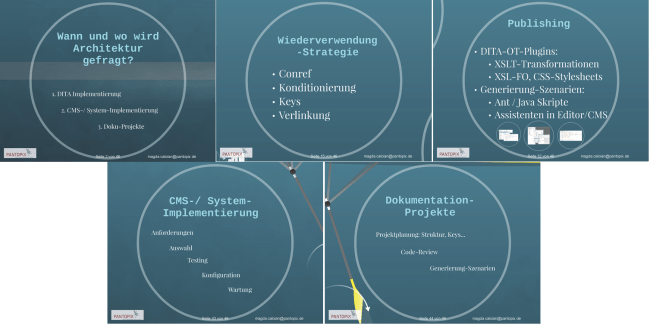
Mein Workshop – Das DITA-Implementierungsprojekt – und der Vortrag – Verstehen Sie DITA-Architektur? – haben erst am dritten Tag stattgefunden. Nichtdestotrotz waren sie gut besucht. Ich hätte mir gewünscht, dass die Workshopräume besser isoliert würden und jeder Teilnehmer einen Platz am Tisch hätte, sodass man bei den Übungen mitmachen konnte… So mussten wir Vieles überspringen, aber die Gruppe war trotzdem aktiv und stellte gute Fragen.

DITA Implementierung - Folien

Gleich danach dürfte ich mehr über DITA-Architektur im riesigen Plenum-Raum berichten… was so komisch auf mich wirkte, dass ich fühlte wie mein roter Faden dahinschwindet. Die Blokade war glücklicherweise nicht von Dauer, da gleich in der nechsten Woche habe ich noch einen Vortrag gehalten und es lief alles prima. Für den Teil über DITA-Architektur hatte ich eigentlich ebenso einen Workshop vorgeschlagen, dürfte aber diesmal nur einen Vortrag daraus machen. Vielleicht klappt es mit dem Workshop bei der Jahrestagung 2015 🙂 So würde ich meinem Publikum durch konkreten Beispielen und Übungen beibringen, was ich ihnen noch schulde.

DITA Architektur Folien

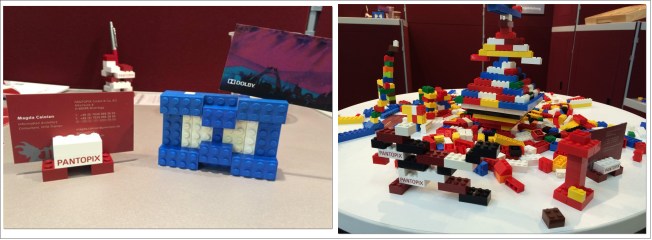
Darüberhinaus war ich in Stuttgart zum ersten Mal als Aussteller mit meinem neuen Arbeitgeber PANTOPIX dabei. Wir haben Freunde und Messebesucher eingeladen, mit uns über ihren Datenmodellen zu reden und dabei mit den Lego-Steinen zu spielen. Außer einer Reihe von Firmenlogos, entstanden ein paar einzigartige Objekte aus der Zusammenarbeit der Standbesucher. Danke fürs Mitmachen!

PANTOPIX Legosteine

Unknown's avatar

Intermezzo: Jang-man’s Transformation Song

Jang Graat at XML Prague 2015

Update: Jang has posted the lyrics of the Transformation song on his techstuff blog.

Unknown's avatar

IA and TechComm at EUROIA14

Continuing my flashback notes, after Brighton and Bucharest, let me take you to the third B-named city I had visited within a month: Brussels. I finally managed to attend EUROIA, the Information Architecture conference in Europe last September. They closed the 10-year loop back in Brussels and I joined just in time to celebrate and received a cool anniversary T-shirt.

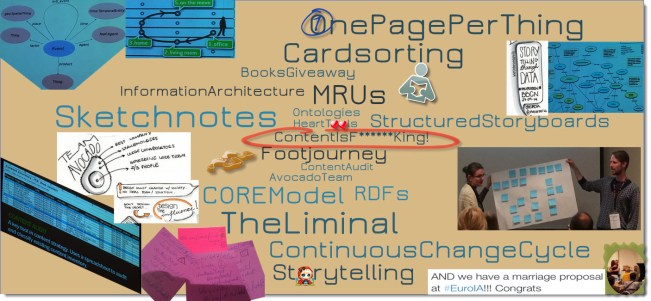
This was quite a change from the usual techcomm conferences. In my “scrapcloud” attempt I mentioned only a few of the terms that stuck with me from EUROIA14, but it was so much more. It took me to the… “liminal”-zone 🙂

EUROIA14 scrapcloud

We were shown the artistic side of information architecture through presentations about design, architecture, innovation, anthropology and psychology. But in the same time, workshops and presentations confirmed that info architects and user experience designers are facing similar challenges technical communicators do. Lots of familiar images: spreadsheets for content auditing, models to sort, chunk and reuse information. One page per thing was an often mentioned rule, as well as MRUs (minimum reusable units). Ontologies and linking are of course vital, since they are the very mechanism that keeps the web running. Does CORE model sound familiar to tech writers yet? It should: Create Once, Reuse Everywhere. And the statement that probably got just as much ovation and Twitter coverage as the marriage proposal in the end, was the reminder that Content is f*** King!

What also seemed a déjà vu, was the effort of info architects to establish their role and responsibilities within companies and workflows. we are all in the center

After seeing in various projects and books those diagrams with all team members or skills in their little circles, all pointing to the project manager (call it scrum master if you will) in the center, then seeing the same in slides trying to define the technical writers’ job and how they should position themselves and communicate with all other roles in their projects… it was the IA and UX designers’ turn to flip the charts.

Good to know we’re not alone and interesting to see we are trying to connect with the same roles in our projects: managers, developers, engineers, testers, etc.

Can hardly wait for the next EUROIA and I hope to see some more conferences adopting their agenda model:  workshops every morning, presentations and lightning talks in the afternoon, dozens of books to give away each evening.